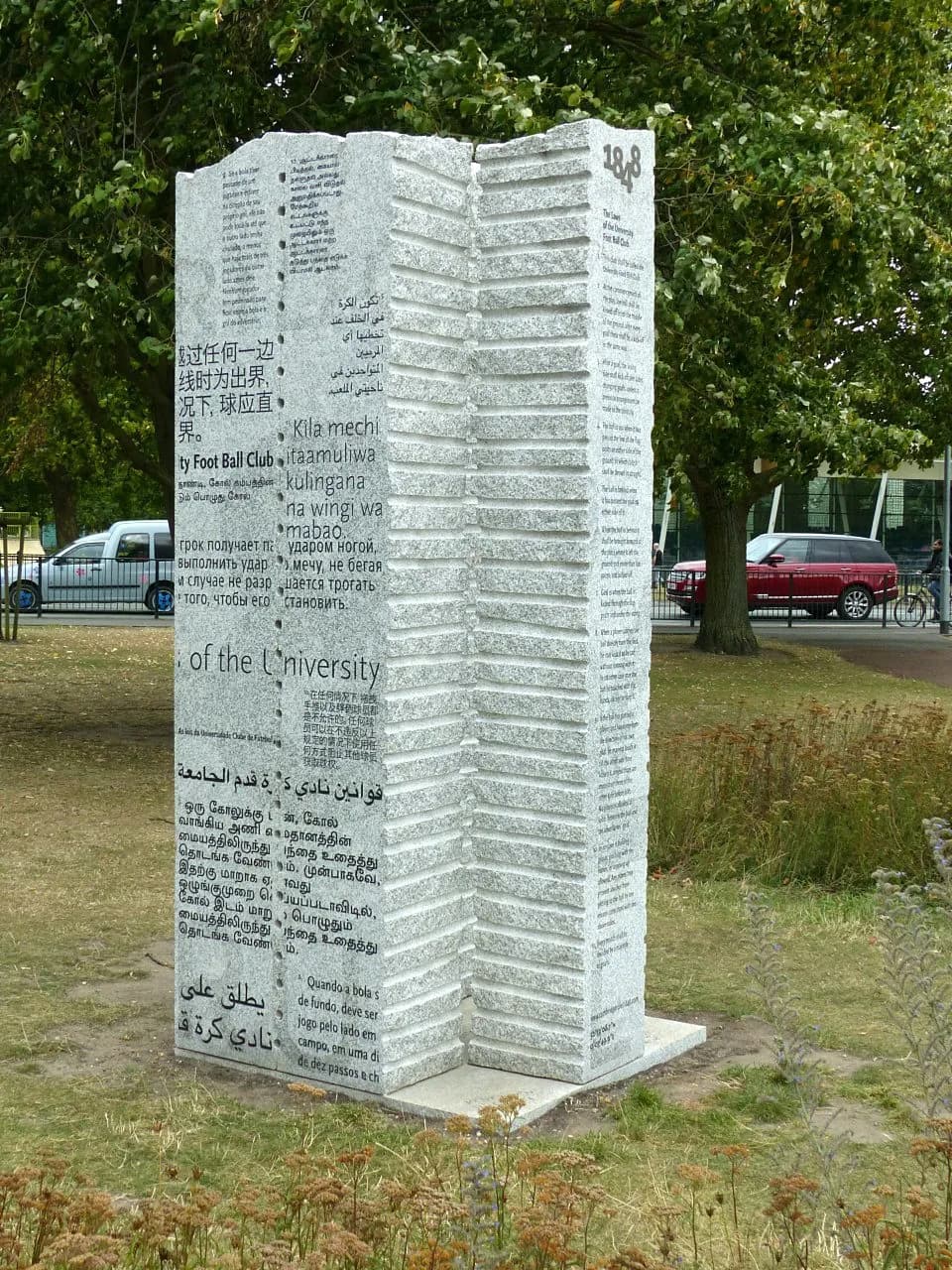
Parker's Piece, the 25-acre common at the heart of Cambridge, is widely recognised as the birthplace of the rules of association football. The codes drawn up by Cambridge students and pasted up on its railings in the nineteenth century provided the foundation for the Football Association's first Laws of the Game in 1863.
The Green at the Centre of the City
Parker's Piece lies near the centre of Cambridge, bounded by Park Terrace, Parkside, Gonville Place, and Regent Terrace. The flat, roughly square grassland has served for generations as a space for cricket, picnics, and informal games. Cambridge City Council notes that it remains a public open space today, used by residents and as the games field for Parkside Community College.
Football on the Piece in the 1830s
Football was already a familiar sight on the common by the 1830s. George Corrie, Master of Jesus College, recorded in 1838 that he had seen some forty gownsmen playing there. At that time, different public schools played by their own codes, making organised contests between old boys difficult.
Early Attempts at a Common Code
Efforts to produce a shared set of rules began in earnest during the 1840s. Edgar Montagu, a Cambridge student and old boy of Shrewsbury School, later recalled that between about 1838 and 1842 he helped form a club with six other Shrewsbury representatives to "equalise the different game." They played two matches on Parker's Piece, but no copy of their rules has survived.
In 1846, H. de Winton and J. C. Thring, also old Shrewsbury boys, persuaded Old Etonians to form a club and play on Parker's Piece. Again, no rules from this attempt are known to exist.
The 1848 and 1856 Cambridge Rules
A more formal effort followed in 1848. Henry Charles Malden, then an undergraduate at Trinity College, wrote in an 1897 letter that a committee of fourteen men representing Harrow, Eton, Rugby, Winchester, and Shrewsbury, together with two university men, met in his rooms to draft a unified code. Malden stated that the resulting Cambridge Rules were printed and "pasted up on Parker's Piece." The document itself has not survived, though Malden maintained that it worked "very satisfactorily."
In 1856 another set of rules was produced. Frederic G. Sykes, a student at St John's College between 1853 and 1857, described in an 1897 letter how a meeting in W. H. Stone's rooms at Trinity College yielded a code signed by ten footballers from Eton, Rugby, Harrow, Shrewsbury, and the University. A copy survives at Shrewsbury School. These rules permitted a free kick after a fair catch, banned holding, pushing, and tripping, and included an offside law requiring four opponents between the attacker and the goal.
The 1863 Code and the Football Association
The process culminated in October 1863, when a committee of nine players representing Shrewsbury, Eton, Rugby, Marlborough, Harrow, and Westminster drew up a fresh set of Cambridge Rules. A newspaper notice announced that "The first game will be played on Friday, 20 Nov, at 2:15 p.m. on Parker's Piece." Significantly, these rules explicitly forbade running with the ball and hacking.
The influence of the 1863 Cambridge Rules on the Football Association was direct. At an FA meeting on 24 November 1863, secretary Ebenezer Morley drew delegates' attention to the Cambridge code, which prohibited carrying and hacking. Discussion of these rules contributed to a delay in finalising the FA's own code until a further meeting on 1 December 1863, when both practices were banned. The FA also adopted the Cambridge offside law almost verbatim. The first FA Laws of the Game were published later that month.
Markers on the Common
Cambridge has marked the site's significance in recent years. In 2000, a plaque was erected on Parker's Piece by a football team of homeless people. It records that students on the common in the 1800s "established a common set of simple football rules emphasising skill above force," and that these Cambridge Rules became the defining influence on the 1863 FA rules.
In May 2018, a monument titled "Cambridge Rules 1848" was installed on the common. It consists of four stone pillars engraved with the 1856 Cambridge Rules rendered in several languages, standing as a permanent reminder of the city's contribution to the world's most popular sport.