The Water That Gave Us Hobson's Choice: How a 17th-Century Conduit Still Flows Through Cambridge
For more than four centuries, fresh water has flowed into Cambridge from springs five miles south of the city. The man who made it possible gave the English language one of its most enduring phrases.
A Public Health Intervention in the Age of Shakespeare
In 1574, Andrew Perne, Master of Peterhouse, first proposed diverting water from Nine Wells near Great Shelford to flush the King's Ditch. By the early 17th century, that defensive channel;excavated in 1265;had become an open sewer threatening public health.
The scheme was revived by James Montagu, Master of Sidney Sussex College, and constructed between 1610 and 1614 at the expense of the University and town. The new watercourse brought fresh drinking water from chalk springs at Nine Wells;four main springheads issuing water at a constant 10.2°C;into the heart of Cambridge.
The conduit served as Cambridge's principal water supply for nearly 200 years. It fed Peterhouse, Pembroke, Christ's, and Emmanuel Colleges. It supplied the old Addenbrooke's Hospital basement. It provided a public dipping point on St Andrew's Street. Most importantly, it flushed the foul King's Ditch, transforming public sanitation in a city that had long struggled with waste and disease.
The Carrier with 40 Horses
Thomas Hobson was born around 1544 in Buntingford, Hertfordshire. He became a postal carrier, operating the mail service between London and Cambridge via the Old North Road. He also ran a livery stable of some 40 horses on land now occupied by St Catharine's College.
Hobson's business acumen extended beyond horses and mail. In 1625, he purchased Anglesey Priory and converted it into a country house. He was a benefactor to St Bene't's Church, where all eight of his children were baptised and where he chose to be buried near the chancel;though without inscription or monument. In 1626, he donated a 1617 edition of the King James Bible to the church.
But Hobson's most enduring legacy was neither his postal service nor his estate. It was a phrase that entered the English language because of how he ran his livery stable.
"This One or None"
Thomas Hobson kept approximately 40 horses for hire. Rather than allowing customers to choose any mount they preferred, Hobson insisted they take the horse in the stall nearest the door. Take that horse, or take none at all.
The phrase "Hobson's choice" emerged from this practice. Its first known written usage appeared in 1660 in Samuel Fisher's "The Rustick's Alarm to the Rabbies." Joseph Addison referenced it in The Spectator in 1712. John Milton, who knew Cambridge well, wrote satirical epitaphs about Hobson that helped popularise both the man and the phrase.
The idiom means what it has always meant: the illusion of choice where only one option is actually offered. It appears in legal judgments, parliamentary debates, and everyday conversation across the English-speaking world. A man who never left his Cambridge stables gave the language a term for false alternatives.
The Conduit Endures
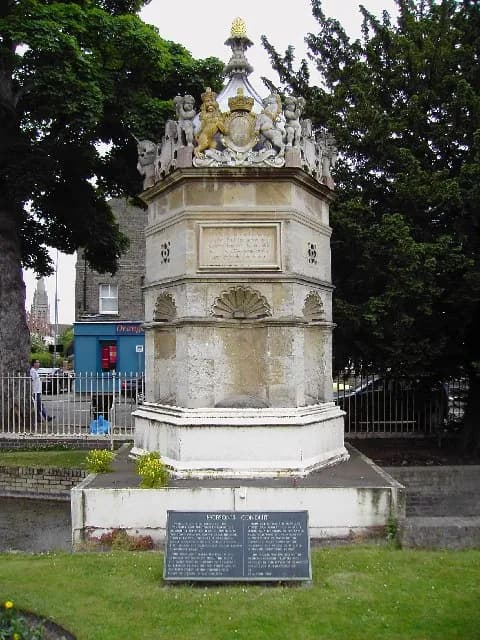
The physical watercourse Hobson endowed remains woven through Cambridge's fabric. The conduit head stands at the junction of Lensfield Road and Trumpington Road, marked by a hexagonal monument to Hobson that was moved there in 1856 after a fire destroyed the original Market fountain.
From the conduit head, the water divides into four branches. The original Trumpington Street branch;known locally as the Pem and the Pot;still carries water from April to September each year. The Market Place branch, completed in 1614, was cut off in 1970 during Lion Yard development and never restored. The St Andrew's Street branch, added in 1631 to feed Christ's and Emmanuel Colleges, was largely covered in 1996. The Parker's Piece branch, which fed a cattle pond, was disrupted when that pond was filled in 1827.
Today the conduit ends at Silver Street, but the Hobson's Conduit Trust;established by Thomas Hobson himself;continues to maintain the watercourse. The structure holds Scheduled Ancient Monument status. The Cambridge City Council Drainage Engineer controls flow through sluices on Trumpington Street.
At Nine Wells, a monument erected in 1861 by public subscription marks the source. The site is now a 1.2-hectare Local Nature Reserve, managed to maintain suitable conditions for bullhead fish and kingfishers. After the 1976 drought caused extinctions among local invertebrates, conservation work continues to restore richer aquatic fauna.
A Cambridge Story Still Flowing
Walk Trumpington Street on a summer day and you can still see water flowing through the narrow runnels beside the road. It is the same watercourse that supplied Milton's Cambridge, that refreshed Cromwell's soldiers, that served the city for two centuries before municipal water systems replaced it.
Thomas Hobson died on 1 January 1631, aged 86. His portrait, painted in 1629, now hangs in the Cambridge Guildhall Szeged Room. Hobson Street and Hobson's Passage still bear his name. Anglesey Abbey, his country house, is now a National Trust property open to the public.
But his most ubiquitous presence remains in the water that still flows through Cambridge, and in the phrase that ensures his name is spoken daily across the English-speaking world. Four hundred years after his death, Cambridge residents still live with the consequences of Thomas Hobson's choices;real and otherwise.